Development of a new modelling platform to study Calcium subcellular behavior in cardiomyocytes
Dec 18, 2025
David Conesa defended his thesis “Empirical and Structural Mathematical Models for Biological Systems: Case Studies in COVID-19 and Cardiac Dynamics” in the EPSEB in Campus Sud on the 18th of December. Under the supervision of Dr. Enric Alvarez Lacalle, the thesis develops different empirical, predictive, and mechanistic mathematical models to study and analyze two branches of biology: epidemiology in the context of a pandemic such as COVID-19, and cardiac dynamics.
Error minimization fit of Gompertz-like models were used to forecast, 2 weeks in advance, increases in COVID-19 incidence using country-level reported data from the WHO during the epidemics. In this thesis, we address the reliability and accuracy of such models. Different data processing methods are used, and the thesis presents a new method to detect the robustness of the predictied best-fit. Continuing with epidemiology, the thesis also presents a study of the correlation between COVID-19 incidence in Spain, province by province, and mobility data from two sources: the Spanish Ministry of Transport and Mobility and Facebook Data for Good. Using tools like Principal Component Analysis and multivariate analysis with delays, the thesis shows that mobility is either directly causal or highly directly correlated with other measures that affected COVID-19 propagation. In contrast, meteorological patterns seem less able to predict outcomes.
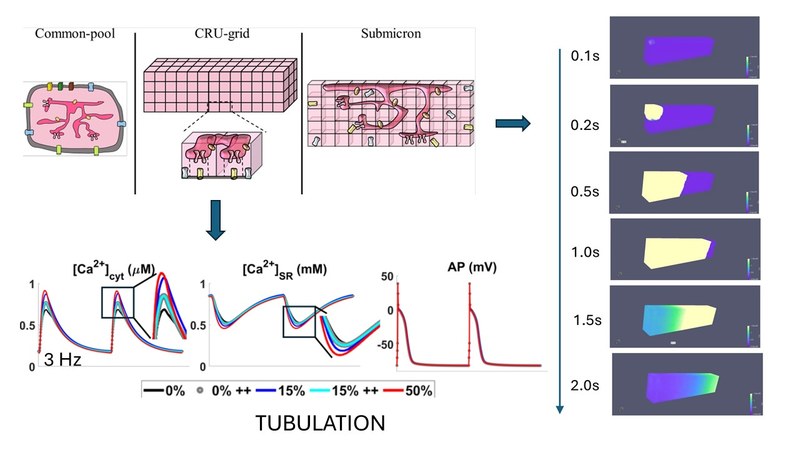
Turning to cardiac dynamics, this thesis has focused on the development of computational models to study calcium dynamics in cardiomyocytes, as a basis for a future platform to link subcellular behavior to whole-organ cardiac diseases. During the process, the thesis develops a novel methodology to build a population-of-models approach. The new methodology is needed to address one of the most important problems in physiological data of cells; some key data to validate the model are in terms of features in a data series rather than a well-known data series. Last but not least, we develop another model at the submicron scale to analyze how subcellular calcium waves originate, propagate, die out, and reappear.
Share: